
2026 DPC Marketing & Growth Comparison: 5 Options for Independent Physicians

Eric Caballero • July 12, 2026

Share this article

Lets compare ...

2026 DPC Marketing & Growth Comparison: 5 Options for Independent Physicians


Physicians researching marketing or growth support for a DPC or concierge practice run into more than just other marketing agencies. Some options are practice operating platforms. Some are national concierge networks. Some are brand studios with no ongoing marketing at all. If you haven't already, our companion piece on how to choose a DPC marketing agency covers the questions worth asking regardless of which option you're considering. This guide goes a level more specific: the five names physicians ask us about most, evaluated against the same criteria, including JumpStart.


Authorship and transparency note: This analysis was prepared by the JumpStart team. As a provider in this space, our priority is to offer a factual, objective comparison based on public information, pricing pages, and each company's own published claims. We're one of the five options covered here, and we've held our own listing to the same standard as the other four.


What to Look For When Choosing a DPC Marketing or Growth Partner


Before comparing specific companies, it helps to know what actually separates a good fit from a bad one. Whatever you're evaluating, weigh it against these factors:


DPC-specific expertise versus general healthcare marketing. Does the provider understand panel economics, membership psychology, and how DPC differs from insurance-based care, or are they applying a generic playbook?


Ongoing marketing versus a one-time deliverable. Does the engagement continue past launch, or does it end once a brand or website is delivered?


Independence versus network affiliation. Does the provider require you to join a platform, network, or franchise-style system, or do you remain fully independent?


Contract transparency. Is pricing public? Is the commitment length and exit process clear before you sign?


Compatibility with your actual model. Some providers assume true DPC (no insurance billing). Others are built for concierge medicine that keeps insurance in place. These are not interchangeable, and the wrong fit here matters more than any marketing tactic.


Who drives the strategy. Is it a dedicated partner who knows your specific practice, or a centralized, templated system applied across hundreds of other accounts?


Two Categories, Not One


Lumping every option into "marketing" misrepresents what most of them actually do. Of the five providers in this guide, three are marketing-focused: they build brand and run growth campaigns, and nothing else. Two are something bigger: a practice operating platform and a national concierge network, where marketing is bundled inside a much larger relationship. We've grouped the providers accordingly, listed alphabetically within each category.


1. Marketing-Focused Providers

(Alphabetical order)

These three providers focus specifically on brand and marketing work for independent practices. None of them require you to join a network or hand over operational control.


Care Identity


Description: A boutique branding and web design studio led by creative director Alexa Torres. The work centers on building a complete brand identity from scratch for a physician-owned practice. See Care Identity's full offering.


What's included: Logo design, full visual identity system, copywriting, and a custom website, delivered as a single project.


Pricing model: Project fee starting around $5,997. No published ongoing retainer option.


When not to choose it: If you need ongoing content, SEO, or campaign management after launch. The engagement is designed to end at delivery, with no built-in path to continued marketing support.

DPC Brand Studio


Description: A Denver-based brand identity studio built exclusively for direct primary care. DPC Brand Studio's own site makes DPC specificity the core of their positioning, unlike Care Identity's more general focus.


What's included: Logo design, full brand identity systems, and asset design (stationery, social templates, patient-facing materials), tiered across four package levels. Smaller commitment-free entry points are also available: a Brand Discovery Session, a Brand Audit, and a Brand Style Guide, each creditable toward a full package.


Pricing model: Packages from $2,500 (Foundational Brand) to $8,500 or more (Elevated Brand). Project-based throughout.


When not to choose it: If ongoing marketing execution matters as much as the brand itself. Campaign development is listed as an available add-on, but it isn't the core of what they do, and the engagement structure is built around a finished identity system, not continued growth work.


JumpStart DPC Solutions


Description: A marketing agency built exclusively for DPC, concierge, and membership-based practices. No other service lines, no practice operations, no franchise structure.


What's included: Brand identity, website development, SEO copywriting, social media, print materials, and ongoing campaign strategy, bundled as a continuous engagement rather than a single deliverable.


Pricing model: A monthly retainer that decreases over the first several months of the engagement. Project-based pricing is also available for practices that want specific deliverables without a long-term commitment.


When not to choose it: If you're still deciding whether to stay fully independent or affiliate with a larger platform or network. That's a bigger decision than marketing, and it should get resolved first. JumpStart is built for practices that have already decided to remain independent.


2. Platform & Network Providers

(Alphabetical order)


These two providers solve a different problem entirely. Marketing is bundled into a much larger relationship, either a full practice operating system or a national physician network, and the decision to use either one isn't really a marketing decision at all.


Freedom Healthworks


Description: A DPC practice operating system based in Indianapolis, organized around four systems: Launch, Operations, Intelligence, and Growth. Freedom Healthworks has helped launch more than 155 practices since 2016.


What's included: Business setup, compliance support, EMR and technology implementation, daily administrative support, and marketing, all delivered as one bundled package. Marketing itself includes a three-month launch program (content calendar, weekly strategy calls, an assigned project manager) plus ongoing materials: newsletters, up to four emails a month, and print collateral. A published network average cites 32 qualified leads and 14 enrollments per practice per month, though that figure is network-wide, not a guarantee for any individual practice.


Pricing model: Full platform contract with a 90-day minimum commitment. One published pricing page cites a total startup investment around $40,199, which covers far more than marketing alone.


When not to choose it: If you want marketing handled by a team whose only job is marketing. Inside Freedom's system, marketing competes with operations, admin, and staffing for the same team's attention, and physicians who join take on the shared “FreedomDoc” network identity rather than a fully independent brand.


MDVIP


Description: A national concierge medicine network headquartered in Boca Raton, Florida, with a network reportedly exceeding 1,300 affiliated physicians. This is the one provider in this guide that is not direct primary care. See MDVIP's own explanation of the model.


What's included: Physician affiliation with a centralized national brand, patient conversion support, and a dedicated practice development manager. Patients keep their existing insurance and continue billing it for routine care; the MDVIP annual fee (commonly cited between $2,500 and $5,000, though MDVIP's own site now says pricing varies by location) funds an additional wellness and prevention program layered on top.


Pricing model: A physician affiliation fee historically reported at around a third of each patient's membership revenue, covering patient conversion, marketing, and brand support. Current exact terms are not published.


When not to choose it: If your practice model depends on operating outside insurance entirely. MDVIP's structure keeps insurance billing in place by design, which makes it structurally incompatible with true DPC, regardless of how well its marketing performs. It's also not a fit if you want a brand built specifically around your individual practice rather than a shared national identity.


The Structural Distinction That Matters Most


The split between these two categories isn't cosmetic. It changes what question you're actually answering.

“Who should market my practice” assumes you've already decided to operate independently. It's a vendor decision: which team executes the strategy, at what cost, under what contract. Care Identity, DPC Brand Studio, and JumpStart all answer this question, just with different scopes.


“Should I affiliate with a platform or network” is a different question entirely, closer to a business structure decision than a marketing one. Freedom Healthworks and MDVIP both answer this question, and marketing happens to be bundled into the answer. If you're still working through whether independence or affiliation is right for your practice, that decision deserves its own conversation with your own financial and legal advisors, separate from any marketing evaluation.


Getting these two questions confused is the single most common mistake we see physicians make when they start this research. It leads to comparing a marketing retainer against a network affiliation fee as if they're the same purchase, when they're not.


One Misconception Worth Clearing Up


Concierge medicine and direct primary care get used interchangeably in casual conversation, but they're structurally different models, and the difference matters for this comparison specifically: MDVIP keeps insurance billing in place, true DPC eliminates it entirely. We've written a full breakdown of that distinction in DPC vs. Concierge: What's the Difference? if you want the complete picture before deciding which model, and which providers on this list, actually fit your practice.


Side by Side

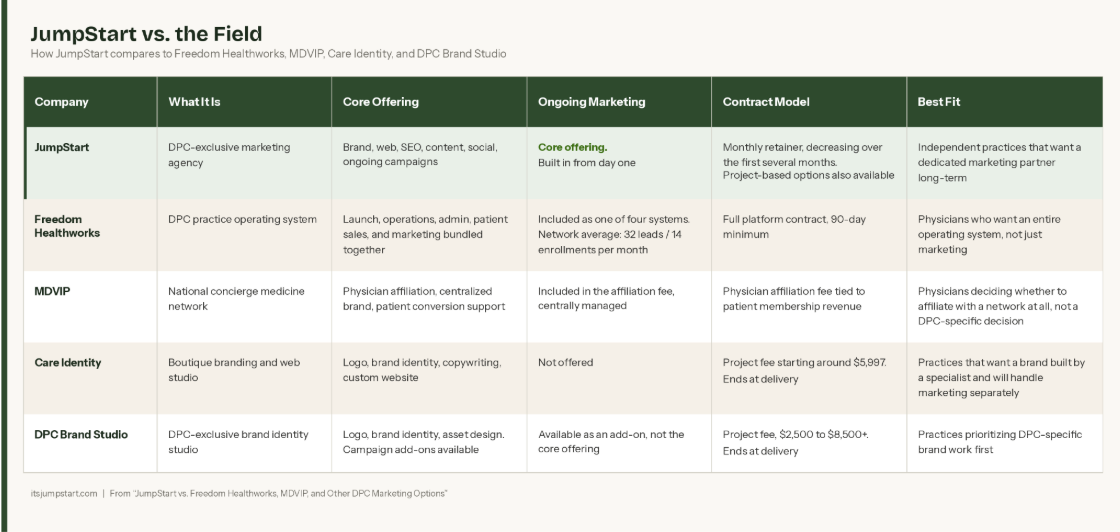
The chart below summarizes what's covered in each entry above: what each provider actually is, what's included, how ongoing marketing is handled, the contract model, and who each one tends to fit best.

Choose Your Provider If:


Choose DPC Brand Studio if you want brand work built by a DPC-specific specialist, and you're comfortable handling ongoing marketing separately or later.


Choose Care Identity if brand quality and creative execution matter most right now, and DPC-specific experience is secondary to overall design caliber.


Choose Freedom Healthworks if you want an entire operating system for your practice, covering far more than marketing, and you're comfortable with a shared network identity and a 90-day minimum contract.


Choose MDVIP if you're evaluating whether to affiliate with a national concierge network at all, and you're comfortable keeping insurance billing in place rather than moving to a fully insurance-free model.


Choose JumpStart if you've already decided to stay independent, and you want a dedicated marketing partner who understands DPC specifically, stays involved past launch, and doesn't require joining anything.


Where to Go From Here


None of these five are a bad choice in their category. The mistake isn't picking a weak option, it's applying the wrong evaluation to the wrong kind of company. A brand studio and a growth marketing agency solve different problems. A marketing vendor and a practice operating platform answer different questions. Once you know which question you're actually asking, the right option on this list tends to be obvious.


If you've landed on marketing as the specific problem to solve, and you want a partner who works exclusively in DPC, we'd be glad to talk through where your practice fits. Schedule a free consultation and we'll walk through your specific situation directly.

Recent Posts

Person raising hand to aska question
By Eric Caballero July 10, 2026
Not every marketing agency understands direct primary care. Here's exactly what to ask before you hire one, and the red flags that should send you walking.

Employers meeting on DPC benefits
By Eric Caballero July 2, 2026
Learn best practices for engaging and attracting employers to your DPC practice. Step by step guide

By Eric Caballero June 2, 2026
If you're reading this in the summer, you might be feeling it already: that mid-year slowdown where patient inquiries dip and your panel growth flatlines. June through August is historically the quietest window for primary care acquisition. People are traveling, kids are out of school, and nobody's thinking about switching doctors. Which makes this the perfect time to build the systems that will fill your panel in the fall. Because here's the thing about DPC patient acquisition: it doesn't happen by accident. You don't have an insurance network sending patients your way. Every member you sign comes from your own effort, your own visibility, and your own reputation. That can feel heavy. But it also means you control it. Here are seven strategies that consistently work for DPC practices. Not theories. Not "best practices" from a marketing textbook. These are the things we've seen move the needle for real practices across the country. 1. Fix Your Google Business Profile Before Anything Else This is the single highest-leverage thing most DPC physicians haven't done properly. When someone in your city searches for a doctor, Google Business Profile determines whether you show up in the map pack (the top three results with the map). If your profile is incomplete, has no reviews, or hasn't been updated in months, you're invisible to the people who are actively looking for care. Here's your checklist: Verify your listing and make sure your name, address, and phone number are accurate Choose the right primary category ("Direct Primary Care" if available; "Family Practice Physician" or "General Practitioner" otherwise) Write a full business description that includes "direct primary care" and your city name Upload at least 10 high quality photos of your office, your team, and your space Add your services, insurance info (or "membership-based" language), and business hours Post an update at least twice a month; Google rewards active profiles Do this before you spend a dollar on ads or social media. It's free, and it's where your most motivated prospective patients are already looking. 2. Ask for Reviews (and Make It Stupid Easy) Reviews are the currency of local healthcare marketing. A practice with 40+ Google reviews and a 4.8 rating will get clicks over a practice with 3 reviews every single time. Patients trust other patients more than they trust your website copy. The problem is that most physicians feel awkward asking. Get over it. Your patients love you. They chose to pay out of pocket for your care. They will leave a review if you ask; they just need a nudge. Create a simple process: Send a follow-up text or email after visits with a direct link to your Google review page Put a small sign in your office with a QR code that goes to your review page Personally ask your long-term patients during their next visit Aim for two to three new reviews per month. That's enough to build momentum and keep your profile fresh in Google's eyes. 3. Build an Employer Outreach List Most DPC practices focus exclusively on direct-to-consumer marketing. That's leaving money on the table. Employer-sponsored DPC is growing fast, and a single employer contract can add 10 to 50 members to your panel overnight. We wrote a full guide on how to market your practice to employers, but here's the short version: Start small. Make a list of 20 local businesses with 10 to 100 employees: think accounting firms, law offices, tech startups, construction companies, restaurants with salaried managers. These are businesses big enough to care about employee benefits but small enough that the owner or HR person will actually take your call. Your pitch is simple: "Your employees get unlimited primary care for a flat monthly fee. No copays, no deductibles for basic care, and same-day or next-day appointments. It reduces ER visits, lowers your overall healthcare spend, and makes your benefits package more competitive." Offer a free lunch-and-learn at their office. Bring materials. Let them ask questions. The DPC model sells itself once you're in the room. 4. Create Content That Answers Real Questions Your blog and social media should answer the exact questions your prospective patients are typing into Google. Not what you think they should be asking; what they're actually asking. Here are search queries with real volume in the DPC space: "What is direct primary care?" "DPC vs concierge medicine" "Is direct primary care worth it?" "Direct primary care [your city]" "How much does DPC cost?" "Can I use insurance with DPC?" Each of those queries is a blog post waiting to be written. Each one is an opportunity to show up in search results and bring a prospective patient to your site. Write in plain language. Answer the question in the first paragraph. Go deeper in the rest of the post. Include a call to action at the end. If you post one article per month targeting a specific keyword, you'll have 12 indexed pages working for you within a year. That compounds. A blog post you write today can bring you patients two years from now. If you want to understand why original content matters so much, we've written about that too. 5. Run a Patient Referral Program Your existing patients are already your best salespeople. They're the ones telling their friends about how they texted their doctor at 8pm and got a response. They're the ones comparing their 45-minute DPC appointments to the 10-minute rush they used to get. Give them a reason to formalize that word of mouth. A referral program doesn't have to be complicated. Options that work: One month free for every referred patient who signs up A gift card ($25 to $50) for each successful referral A simple "thank you" note or small gift (people appreciate being appreciated) Track referrals so you know which patients are your best advocates. Those are the people you want to feature in testimonials, invite to events, and keep closest. 6. Partner with Complementary Local Businesses DPC physicians often exist in a bubble. Your practice, your patients, your office. But the people you want to reach are already spending time and money at other local businesses. Think about who shares your ideal patient profile: Gyms and fitness studios (health-conscious adults) Financial advisors and accountants (people who understand value-based spending) Wellness practitioners: chiropractors, therapists, nutritionists HR consulting firms (employer channel) Real estate agents (new residents need a doctor) Approach these businesses with a partnership pitch. Leave brochures at their offices. Offer to co-host a community event. Set up a cross-referral arrangement. You're not competing with any of them; you're complementing what they already do. 7. Show Up in Your Community (Physically) Digital marketing matters. But DPC is a relationship-based model, and relationships start in person. Get out of your office: Set up a booth at your local farmers market Sponsor a youth sports league and attend the games Host a free health screening event at a community center Attend your local Chamber of Commerce meetings Speak at a Rotary Club or business networking group Every one of these puts you face to face with potential patients in a low-pressure setting. They see you as a real person, not a website. That matters more than any ad you'll ever run. If you're looking for seasonal ideas on how to translate community outreach into panel growth, read our guide on back-to-school marketing for DPC practices for a tactical example of how this works. The Strategy Behind the Tactics These seven strategies aren't random. They map to the three things every DPC practice needs: Visibility: Can people find you? (Google Business Profile, content, community events) Credibility: Do they trust you when they do? (Reviews, partnerships, your website) Conversion: Can they easily take the next step? (Clear CTAs, referral programs, employer pitches) If you're strong on visibility but weak on credibility, people find you and then choose someone else. If you have great credibility but no visibility, nobody finds you in the first place. All three have to work together. Building a strong brand identity ties all three together: it makes you more findable, more trustworthy, and easier to choose. The Summer Slowdown Is Your Runway Don't wait until September to panic about panel growth. Use June, July, and August to build the infrastructure: set up your Google Business Profile properly, write three blog posts, build your employer outreach list, launch a referral program. When the fall rush hits and patients start searching for new doctors, you'll be the one they find. If building all of this feels overwhelming (because you're also, you know, practicing medicine), that's exactly why JumpStart exists. We build DPC marketing systems so you don't have to figure it out alone. Let's build your patient acquisition engine. Schedule a free consultation and we'll map out what makes sense for your practice. Frequently Asked Questions About DPC Patient Acquisition How long does it take to fill a DPC patient panel? Most DPC practices take 12 to 24 months to reach a full panel of 400 to 600 patients. The timeline depends on your market, your marketing effort, and whether you're doing direct-to-consumer, employer, or both. Practices that invest in consistent marketing from day one tend to reach capacity faster. What is the best way to get new patients for a DPC practice? The highest-impact combination is a well-optimized Google Business Profile, steady patient reviews, one to two blog posts per month targeting relevant keywords, and active employer outreach. Referral programs and community partnerships round out the strategy and tend to convert at the highest rate. Should DPC practices use paid advertising? Paid ads (Google and Facebook) can accelerate growth, but they work best when your foundational marketing is already in place: a strong website, a complete Google Business Profile, and enough reviews to build trust. Without those, you'll pay for clicks that don't convert. How do I market my DPC practice to employers? Start with a targeted list of 20 to 30 local businesses with 10 to 50 employees. Create a one-page leave-behind and a short slide deck. Offer a free lunch-and-learn at their office.  For the full playbook, read our guide: Why Employers Are Choosing DPC in 2026.

By Eric Caballero May 14, 2026
What Is Direct Primary Care Marketing? A Complete Guide for DPC Physicians

By Jo Flores May 14, 2026
Whether Google or ChatGPT, being there when potential patients are searching, matters!

May 14, 2026
The unbiased truth of DPC Marketing
Google phone screen
By Eric Caballero April 26, 2026
Optimize your Google Business Profile as a DPC physician. Follow our tips to attract more patients today!
By Eric Caballero April 26, 2026
If you're a physician exploring practice models outside of traditional fee-for-service medicine, you've probably come across both of these terms. And you've probably noticed that people use them interchangeably, which doesn't help at all. Direct Primary Care and concierge medicine share some DNA. Both offer smaller patient panels, longer appointments, and more personal relationships with patients. Both charge a membership or retainer fee. From a distance, they look like the same thing. They're not. The differences matter, especially when it comes to how you run your business, how you get paid, and how you market your practice to patients. The Core Difference: Insurance This is the dividing line, and everything else flows from it. Concierge medicine charges patients a membership fee (often called a retainer) for enhanced access and longer visits. But the practice also bills insurance for clinical services. The retainer covers the "extras": guaranteed same-day appointments, direct phone access, longer visits, sometimes wellness planning. The actual medical care still runs through insurance. Direct Primary Care eliminates insurance from the equation entirely for primary care services. Patients pay a monthly membership fee, and that fee covers everything: office visits, basic labs, procedures, phone and text access, sometimes even medications at cost. No insurance billing. No copays. No claims. That single distinction creates two very different business models, patient experiences, and marketing challenges. How They Compare Side by Side Patient panel size Concierge practices typically carry 200 to 600 patients. DPC practices run 400 to 800, though many cap at 600. Both are significantly smaller than a traditional primary care panel of 2,000 to 2,500, which is where the longer appointment times and better access come from. Cost to the patient Concierge retainers tend to run higher: $1,500 to $5,000+ per year, sometimes much more for "VIP" concierge practices. The patient also still pays insurance premiums and may have copays or deductibles for the clinical services billed through insurance. DPC memberships typically run $50 to $150 per month ($600 to $1,800 per year). That fee covers primary care with no additional billing. Many DPC patients pair their membership with a high-deductible health plan or health share for catastrophic and specialist coverage. Who the patient is Concierge medicine tends to attract higher-income patients who can afford both the retainer and full insurance coverage. The value proposition is access and convenience on top of traditional insurance. DPC attracts a broader range of patients: young adults without employer insurance, self-employed professionals, small business employees, families looking for a better primary care experience, and people frustrated with the insurance system. The value proposition is better care at a lower total cost. Administrative burden Concierge practices still deal with insurance: coding, billing, prior authorizations, claim denials, compliance. The retainer adds revenue but doesn't remove the paperwork. DPC practices eliminate insurance administration almost entirely. No billing department. No coding headaches. No prior auth calls. This is one of the biggest operational advantages of the DPC model and a major reason physicians choose it. Revenue model Concierge revenue comes from two streams: the retainer fee plus insurance reimbursement. This can be lucrative but creates dependency on two separate systems. DPC revenue comes from one stream: membership fees. It's simpler, more predictable, and easier to forecast. But it also means every dollar comes directly from patient acquisition and retention. There's no insurance network sending patients your way. Why This Matters for Marketing This is where the conversation gets relevant for your practice growth. Concierge practices can lean on their insurance network participation to drive some baseline patient volume. The retainer model layers on top of an existing referral and discovery infrastructure. DPC practices have to build that infrastructure from scratch. You need to educate patients on what DPC even is, because most people have never heard of it. You need to explain why paying a monthly fee for a doctor makes sense when they already have insurance through work. You need to show up in local search results when patients look for affordable, accessible care. The marketing playbook for a concierge practice and a DPC practice are not the same. A marketing agency that treats them as interchangeable will waste your money. The messaging is different. The target audience is different. The objections you need to overcome are different. This is exactly why JumpStart focuses exclusively on DPC. We understand that your marketing challenges are specific to this model, and we build strategies around that reality. Which Model Is Right for You? That's a decision only you can make, and it depends on your financial goals, your tolerance for insurance administration, the demographics of your area, and what kind of practice you want to run day to day. But if you've already chosen DPC, or you're leaning that way, the most important thing to understand is that your marketing can't be generic. The patients you need to reach don't know what DPC is. The employers you should be pitching are actively looking for alternatives to traditional insurance. And the message that resonates with your audience is fundamentally different from what works for a concierge practice. Thinking about how to position and grow your DPC practice? Schedule a free consultation and let's figure out the right approach for your market. Frequently Asked Questions Is DPC the same as concierge medicine? No. Both offer smaller panels and more personal care, but concierge medicine charges a retainer fee on top of insurance billing, while DPC charges a monthly membership that covers all primary care services without involving insurance. The business models, patient demographics, and marketing strategies are different. Is DPC cheaper than concierge medicine? For patients, yes. DPC memberships typically run $50 to $150 per month. Concierge retainers often range from $1,500 to $5,000+ per year, and the patient still pays insurance premiums and potential copays. DPC tends to attract a broader income range as a result. Can I bill insurance and run a DPC practice? By definition, DPC does not bill insurance for primary care services. Some practices operate a hybrid model where they bill insurance for certain services, but this is not standard DPC and introduces the administrative complexity that most DPC physicians specifically want to avoid. Why does the DPC vs. concierge distinction matter for marketing? Because the target audiences are different. Concierge patients already have insuranc e and are paying extra for premium access. DPC patients are often looking for an alternative to insurance-based care entirely. The messaging, the objections, and the channels that work are different for each model.
Five coworkers in a meeting around a white table, reviewing charts and laptops in an office.
By Eric Caballero March 27, 2026
Explore HSA eligibility & employer pipelines for DPC growth. Get strategies to enhance your practice today!
Person writing in a notebook next to a laptop and smartphone at a cafe table, with a Pantone color swatch: 7576 C.
By Eric Caballero November 6, 2025
In the digital age, having a compelling online presence is crucial for any business, including Direct Primary Care practices. One of the most vital elements of a successful website is original content. But why is it so important to have 100% original content on your DPC website? Let's explore the reasons.
Show More